SHARE

Tennis Scoring Rules: 15-30-40, Deuce and Tie-break Explained

How is tennis scored? The 15-30-40 count, deuce and advantage, the tie-break and super tie-break, serve and doubles rules, keeping score in casual matches, and the Racket Crush Apple Watch app.

October 12, 2026Updated October 23, 20269 min read
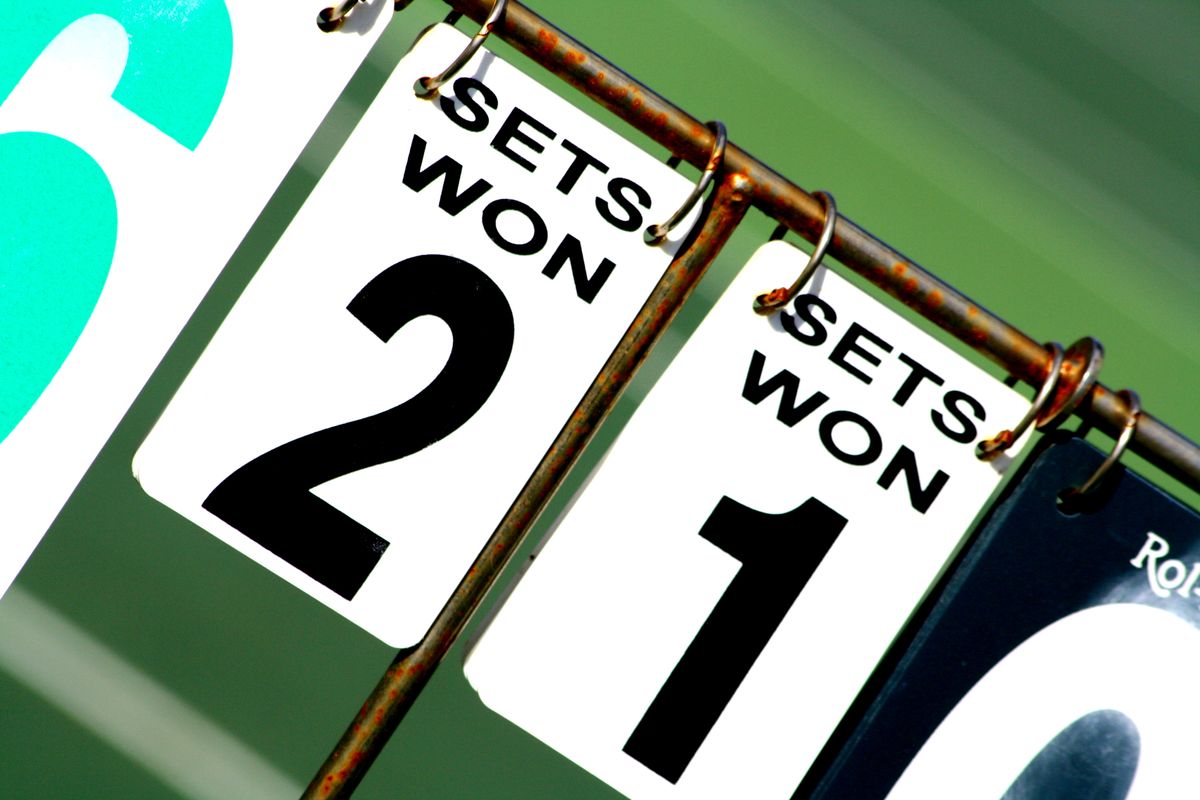
A tennis scoreboard showing sets won at 2–1

How is tennis scored?

The first question most new players ask is the same: why do points go 15, 30, 40 instead of 1, 2, 3? Tennis scoring has four layers. Points make games, games make sets and sets make the match. To win a game you need four points and a lead of at least two. To win a set you need six games and a lead of at least two; at 6-6 the set is decided by a tie-break. Most casual matches are best of three sets. In short:

  • Points: 0 · 15 · 30 · 40 · game
  • Game: 4 points and a 2-point lead
  • Set: 6 games, tie-break at 6-6

Why 15, 30, 40?

Nobody knows for certain. The count is thought to go back to jeu de paume, the medieval French ancestor of tennis. The most popular explanation is a clock face: the score was kept on a clock and the minute hand moved a quarter turn per point, to 15, 30, 45 and 60 for the game. The story goes that 45 was later shortened to 40, so that at 40-40 the advantage landed on 50 and the game on 60. The usual explanation for calling zero "love" is the French l'oeuf, egg, for its shape. Historians still argue over both, but today's count is the same everywhere: 0, 15, 30, 40 and game.

Points, games, sets and the match

A point is the smallest unit: it starts with a serve and ends when the ball is out of play. A game goes to the side that wins four points with a lead of at least two. A set goes to the side that wins six games with a lead of at least two, such as 6-4 or 7-5. At 5-5 the set runs to 7-5; at 6-6 a tie-break is played. The match goes to the side that first wins the agreed number of sets. Most professional events and the women's Grand Slam draws are best of three sets; men's Grand Slam matches are best of five. The official text is the Rules of Tennis, updated every year by the International Tennis Federation (ITF).

Deuce and advantage

When both sides have won three points in a game, the score is 40-40, called deuce. From deuce you need two points in a row to win the game. If the server wins the next point it is advantage server; if the receiver wins it, advantage receiver. Winning the next point from advantage wins the game; losing it takes the score back to deuce. This repeats until one side is two points ahead. A point won from advantage receiver is a break of serve. Some doubles events and time-limited club matches use no-ad scoring: at 40-40 a single deciding point is played and whoever wins it takes the game. In professional doubles the receiving team chooses which side receives that deciding point.

How does a tie-break work?

When a set reaches 6-6 in games, a tie-break decides it. The 15-30-40 count is dropped and points are counted 1, 2, 3. The first side to reach 7 points with a lead of at least 2 wins the set 7-6; from 6-6 it continues until someone leads by 2 (8-6, 9-7, 12-10 and so on). The player whose turn it is opens with one serve; then the serve passes to the opponent and each player serves twice in turn. Players change ends whenever the points add up to 6 or a multiple of 6. The player who served first in the tie-break receives in the first game of the next set.

The super tie-break (10-point tie-break)

A super tie-break is a tie-break played to 10 points instead of 7, still with a lead of at least 2. You will meet it in two places. First, as the match tie-break that replaces the third set in professional doubles and in many club and amateur events: at one set all, a 10-point tie-break is played instead of a full set. Second, since 2022 all four Grand Slams play a 10-point tie-break when the final set reaches 6-6. Before that each event had its own rule, and final sets sometimes ran for hours.

Tennis game and tie-break formats compared
FormatCountTo winWhen level
Standard game0, 15, 30, 404 points and a 2-point lead40-40 is deuce; 2 points in a row needed
No-ad game0, 15, 30, 40First to 4 pointsOne deciding point at 40-40
Tie-break1, 2, 3…7 points and a 2-point leadFrom 6-6, until someone leads by 2
Super tie-break1, 2, 3…10 points and a 2-point leadFrom 9-9, until someone leads by 2

Serve rules

Every point starts with a serve, and the server has two attempts. If the first serve is a fault, a second is played; if that is a fault too, it is a double fault and the point goes to the opponent. The serve goes diagonally and must land in the opponent's service box. The first point of each game is served from the right, then sides alternate every point. Touching the baseline or stepping inside it while serving is a foot fault, and that serve counts as a fault. If the ball clips the net and lands in the correct box it is a let: not a fault, the serve is replayed. The serve passes to the opponent at the end of every game.

Doubles differences

Doubles scoring is the same as singles; what changes is the court and the order. The serve goes into the same service box, but once the serve is returned the side alleys are in play. The serve rotates between teams: one player of team A, then one of team B, then A's other player, then B's other player, and this order holds for the whole set. On the receiving team each player receives from the same side (deuce or ad) throughout the set; teams may switch at the start of a new set.

Keeping score without arguments in casual matches

Without an umpire, most disputes come from a forgotten score. The easiest fix is for the server to call the score out loud before every serve, their own score first, such as 30-15. You call the balls that land on your side of the net; if you are not sure, the ball is in. The ITF's code of conduct for unofficiated matches says the same. Players change ends after the odd games of each set (1-0, 2-1, 3-2 and so on): straight away after the first game, with a break of up to 90 seconds at later changes. If you have the court for a fixed time, agree the format before you start: with limited time, no-ad games or a super tie-break instead of a third set keep the match from being left unfinished.

Keep score from your wrist: the Racket Crush Apple Watch app

The easiest answer to "was it 30-15 or 15-30?" is to keep the score on your wrist. In the Racket Crush Apple Watch app you start the match on the watch and choose who serves first; after each point you tap the box of the side that won it. The watch applies the rules in this guide on its own: the 15-30-40 count, deuce and advantage, a 7-point tie-break at 6-6 in games, and best of three sets. You can undo a wrong tap, edit the score by hand or pause the match. The match is saved to Apple Health as a tennis workout; if you allow it, match duration, heart rate and active calories are kept with it. When the match ends, the score moves to Racket Crush on your phone: in singles it goes to your opponent to confirm, and for doubles or padel you pick the teams and save. A Samsung Galaxy Watch (Wear OS) version is also in the works.

Find a tennis partner at your level

Once you know the rules, the next step is finding someone to play with regularly. Racket Crush is free and covers tennis, padel, squash, badminton and pickleball. When you sign up you pick your level for each sport with a short questionnaire; it shows on your profile, you can update it any time, and it does not change on its own with match results. In Discover you see players near you and message the people you match with. You can open a singles (1v1) or doubles (2v2) match and accept the requests yourself. Courts are shown on a map in the app, and you book directly with the venue. After the match one side enters the score and the other confirms or rejects it; a score from the Apple Watch app goes through the same confirmation.

WITH RACKET CRUSH

Find a tennis partner, record your match

Pick your level → discover players near you → open your match → enter the score or keep it on your Apple Watch, and let your opponent confirm.

Download the app

Frequently Asked Questions

How do you call the score in tennis?
The server calls the score with their own points first: 30-15 means the server has 30 and the receiver 15. Level scores are called "15 all", "30 all"; 40-40 is deuce. The game score is given the same way, with the server's games first.
How is the serving order decided?
By a coin toss or racket spin before the match; the winner chooses to serve, receive or pick an end. The serve passes to the opponent at the end of every game. In a tie-break the first player serves once, then the serve alternates every two points.
When do players change ends in a tie-break?
Whenever the points add up to 6 or a multiple of 6: at 4-2, 5-1, 6-6 or 9-3, for example. The rule is the same for 7-point and 10-point tie-breaks.
What happens at 6-5 in a set?
If the leading player wins the next game, they take the set 7-5. If the trailing player wins it, the score is 6-6 and the set is decided by a tie-break.
What if the serve hits the net?
If the ball clips the net and lands in the correct service box, it is a let and the serve is replayed; it is not a fault and there is no limit on lets. A serve that hits the net and lands out, or does not clear the net, is a fault.
Is there a tie-break in the final set at Grand Slams?
Yes. Since 2022 the Australian Open, Roland Garros, Wimbledon and the US Open play a 10-point tie-break when the final set reaches 6-6; the first to 10 points with a 2-point lead wins the match.

Related posts